
Let’s talk risk. Not the “I just YOLO’d into crypto” kind of risk. I mean the kind that shows up in your portfolio, your business, your wealth-building journey, and determines whether you’re compounding toward freedom or blowing up on the launchpad.
Risk isn’t a math problem—it’s a mindset problem.
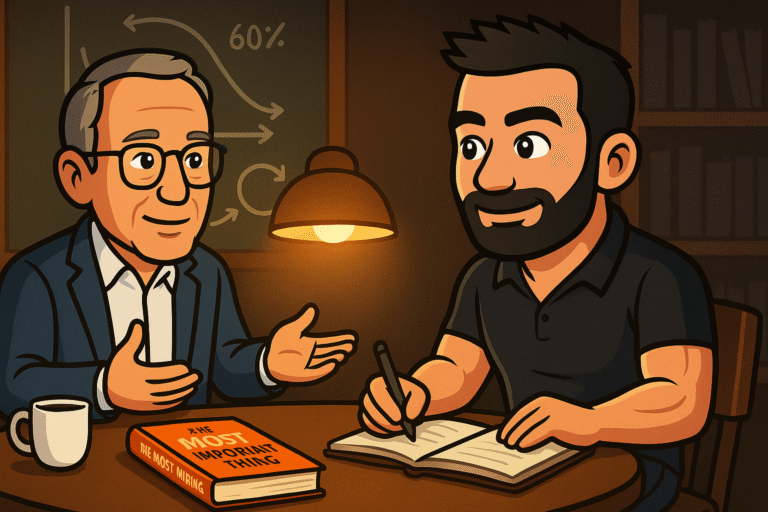
In a world obsessed with returns, volatility, charts, and backward-looking models, Howard Stanley Marks cuts through the noise with timeless wisdom on what risk really means and why most people don’t get it. He is an American investor and writer, the co-founder and co-chairman of Oaktree Capital Management, which is the largest investor in distressed securities worldwide. I find his insights fascinating.
I recently re-watched his full 10-part series in one sitting. It’s loaded with gold. I’m boiling it down for you but I encourage you to watch the entire series for yourself.
Why This Matters
Whether you’re building your wealth through entrepreneurship, real estate, public markets, or a corporate career, risk is the invisible force shaping your outcomes.
Ignore it, and you’re flying blind. Understand it, and you’re putting the power of compounding on your side.
Here are the 10 big lessons from Howard Marks on how to think about risk:
1. Risk Is the Probability of Permanent Loss—Not Volatility
Wall Street’s favorite definition of risk is volatility. Marks calls bullsh*t.
Volatility just tells you how much something moves. Real risk is about permanently losing money. It’s the difference between a drawdown and a disaster. A price decline doesn’t hurt you unless you’re a forced seller.
Translation: If you believe in the asset and can hold through the storm, volatility is noise, not risk.
2. Risk Can’t Be Measured With Precision
This one will make spreadsheet lovers cringe: you can’t calculate risk like you can ROI.
Risk lives in the future. It’s uncertain, squishy, and emotional. Two people can look at the same investment and see wildly different risk profiles, based on experience, temperament, or even how much coffee they have consumed (only half joking).
Bottom line: Risk is not a number. It’s a judgment call.
3. Returns Without Context Are Meaningless
Marks introduces three fictional investors:
-
One who lags in bull markets but shines in bear markets.
-
One who surges in bulls but crashes in bears.
-
One who barely keeps up on the upside but loses less in downturns.
The third one is the real star.
Why? Because investing isn’t about hitting home runs. It’s about consistency, control, and avoiding wipeouts. The best investors aren’t the flashiest—they’re the ones still standing.
4. There Are Many Forms of Risk—Not Just Market Risk
Think beyond stock prices:
-
Liquidity risk
-
Leverage risk
-
Concentration risk
-
Behavioral risk (panic-selling at the bottom)
-
Opportunity cost
Marks worries most about forced selling. If you’re leveraged, overexposed, or psychologically unprepared, you may be forced to sell during chaos—and that’s when compounding dies.
5. Not All Risk Is Visible
The biggest risks often come when everything feels safe.
Remember 2006? Real estate was “safe.” Or 1999—tech stocks could “only go up.” These periods lull people into overconfidence. That’s when real damage is done.
Risk hides best in good times. Complacency is a killer.
6. You Need Risk to Make Money—But Not Recklessness
Avoiding all risk = avoiding all return. The goal isn’t zero risk—it’s intelligent risk.
Marks says investing is like navigating a foggy road. You can’t see far, but you keep driving—carefully, alert, with margin for error.
You need to risk missing out to avoid blowing up. There’s a sweet spot between paranoia and blind optimism. Find it.
7. “Risk On” and “Risk Off” Aren’t Binary
Some investors try to time the market by flipping a switch—100% in, 100% out. Marks thinks that’s foolish.
Risk isn’t an on/off button. It’s a dial. The best investors adjust exposure gradually—scaling risk based on environment, opportunity, and valuation.
Note: This is why I keep cash when others are greedy and get aggressive when there is blood in the streets (or more realistically, red on the screen). It’s not about timing tops and bottoms—it’s about playing the odds with a margin of safety.
8. You Can’t Eliminate Risk—Only Manage It
No strategy is risk-free. Bonds, real estate, private equity, crypto, even cash—each comes with its own demons.
What you can do is:
-
Diversify intelligently.
-
Avoid overconcentration.
-
Understand what you own.
-
Know your behavior under pressure.
Note: I personally prioritize peace of mind over the highest return I can achieve, which means I use little to no leverage in my life and always maintain dry powder in the form of cash or short-term treasuries.
9. The Biggest Risk is Psychological
Howard hits hard here: you can know everything and still lose because of emotion.
Fear. Greed. Envy. Regret. These are the true risk factors most people never model for, but they drive the worst decisions.
Risk lives not just in markets but in your mind.
10. You Don’t Get Paid for Taking Risk—You Get Paid for Handling It
This is the mic-drop moment.
Everyone “takes risk,” but few handle it well. Marks says the best investors don’t just chase return—they earn it by living through discomfort, being patient, and doing the hard things when others won’t.
In short: you get paid to suffer intelligently.
Final Thought
Risk isn’t a monster to be feared. It’s a force to be understood.
In my own journey—from launching GYFG at 27, breaking into the C-suite by 30, and leaping into entrepreneurship 32 to investing all along the way across startups, real estate, private market deals, and public markets—I’ve learned that risk is the price of admission to a life on your terms.
But like anything worth having, you’ve got to respect the price. That means knowing yourself, playing the long game, and thinking in decades, not days.
So here’s the question:
What risks are you ignoring right now because they “feel” safe?
And what opportunities are you avoiding just because they “feel” scary?
Food for thought, Compounders.
– Gen Y Finance Guy